Sobers : The Sun of Barbados – When the Don Met the King
There is a widely held belief, a sort of cricketing gospel, that the game began and ended with the statistical tyranny of Donald Bradman. For decades, the Don’s 99.94 was the sun around which all other planets orbited—a cold, calculated perfection that left no room for debate. It was a monochromatic excellence, built on the relentless accumulation of runs and the clinical dissection of bowling attacks.
But statistics are mere ledger entries; they are not the soul of the game.
To find the soul, one must look away from the dusty record books and toward the Caribbean horizon, where a young man from Barbados stood ready to redefine the very boundaries of human capability. If Bradman was the scientist of the crease, Sir Garfield St Aubrun Sobers was its sorcerer. He did not merely play the game; he expanded its dimensions until the very concept of a “specialist” felt small and unimaginative.
The Five-Pronged Sword
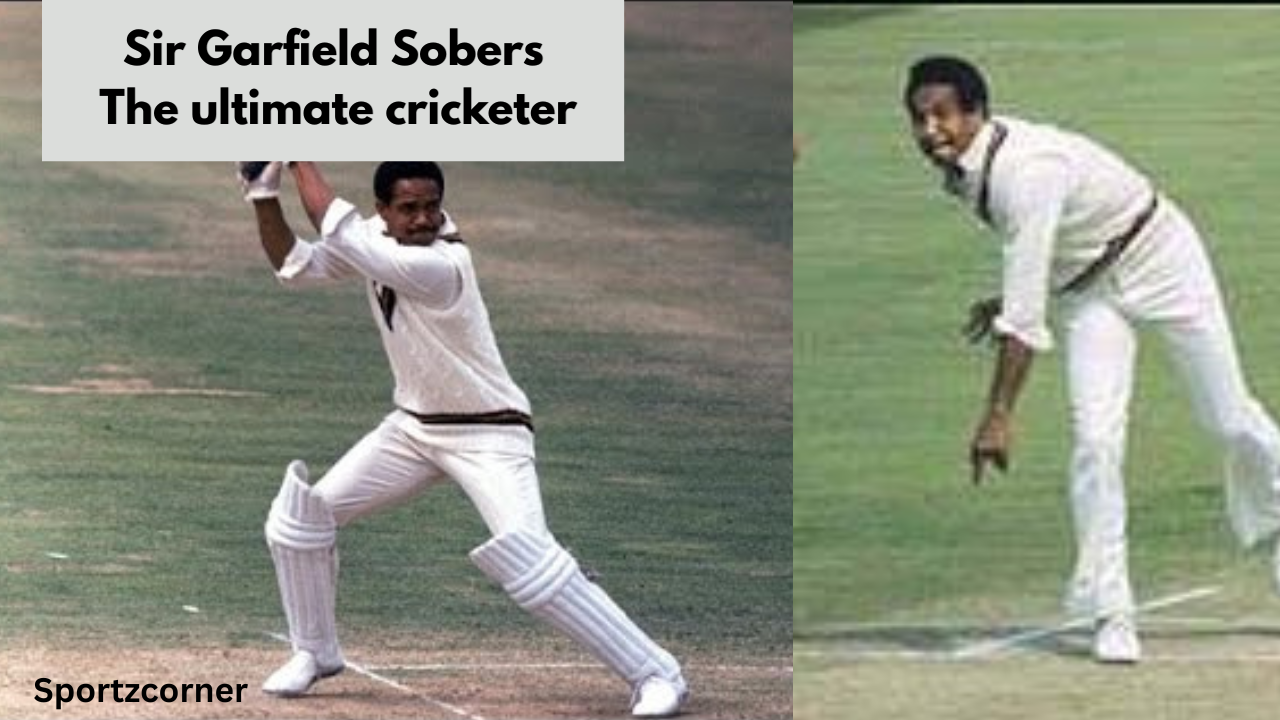
Imagine, for a moment, the sheer audacity of a man who refused to be pigeonholed. In the rigid hierarchy of cricket, one is usually a craftsman of the willow, a merchant of pace or a magician with spin. Sobers was different. When they created him they seemed to have poured all the goodies in into one elegant form. Never before had someone done everything and done all of it with utter disdain and authority. Sobers dominated every blade of grass on the field with a presence that felt unreal.
When he took the ball, he was a chimera. He could bowl with the steely resistance of a genuine fast-medium opening bowler, his rhythmic, bounding run-up culminating in a delivery that hummed past the batsman’s ears with venomous intent. Then, with a nonchalant shrug, he would shorten his stride to bowl the noble craft of slow left-arm orthodox. If the pitch demanded more, he would transition seamlessly into wrist-spin, deliveries biting and turning in spite.
He was a almost a cricket team distilled into one majestic frame.
The Massacre at Swansea
The year was 1968. The setting was St. Helen’s, Swansea—a ground that usually hummed with the quiet, industrious sounds of County cricket. The victim was Malcolm Nash. Until that afternoon, the idea of hitting six sixes in a single over was a fever dream, a feat of flamboyant audacity that existed only in the imaginations of schoolboys or the tall tales of the village green. six sixes in an over was a amongst the kind of stories that are treated as imagination in a noisy bar late in the evening.
But Sobers, captaining Nottinghamshire, decided it was time to turn myth into archival fact. The first ball was bludgeoned over long-on with a sound like a pistol shot. The second and third soared into the stands, the crowd’s murmurs turning into a roar of disbelief. By the fourth, Nash looked less like a competitor and more like a man watching his house burn down.
The fifth ball actually crossed the ropes via a fielder’s hand, but the sixth—the final act of this exhibition of carnage—was a statement of pure intent. It sailed out of the ground . Sobers was launched into the annals of immortality.
It wasn’t a game of cricket; it was a poetic orchestra conducted in the middle of a park.
The Valedictory Shadow
Sir Neville Cardus, the high priest of cricket literature, once observed that Sobers was “the most complex and versatile genius” the game had ever seen. This was high praise from a man who lived in the shadow of the Golden Age. Even the Don, usually so guarded with his praise and protective of his pedestal, had to concede ground to the Barbadian.
When Bradman watched Sobers bat, he saw a reflection of a spirit he himself never fully possessed—a nobility that favored the spectacular over the safe. Where others waded through the nervous nineties with a stuttering heart and a defensive prodding, Sobers galloped. His 365 not out against Pakistan in 1958 wasn’t just a record; it was a marathon run at the pace of a sprint. He did not accumulate runs; he plundered them. He brought a “Calypso” rhythm to the crease that made the most desperate bouncer look like an invitation to a tango.
The Lingering Echo
As the shadows lengthen over the modern game—now cluttered with power-hitters, data-driven strategies, and measured boundaries—the legend of Garry Sobers glows with an even fiercer, more romantic light. He remains the yardstick for greatness, the ghost that haunts every “all-rounder” who dares to pick up both a bat and a ball.
Sobers moved with the grace of a panther and struck with the force of a thunderbolt, proving that while numbers might define a career, it is the spirit of the artist that defines an era. He was the ultimate counter-attack against the ordinary and the mundane.
Richie Benaud, a man who saw every great of the modern age, perhaps put it best when he looked at the sprawling, multi-faceted legacy of the King and whispered the only truth that mattered:
“The greatest all-round player the world has ever seen or is likely to see.”
Benaud knew his stuff and could not have been any more correct.