
Arsenal’s long wait is over
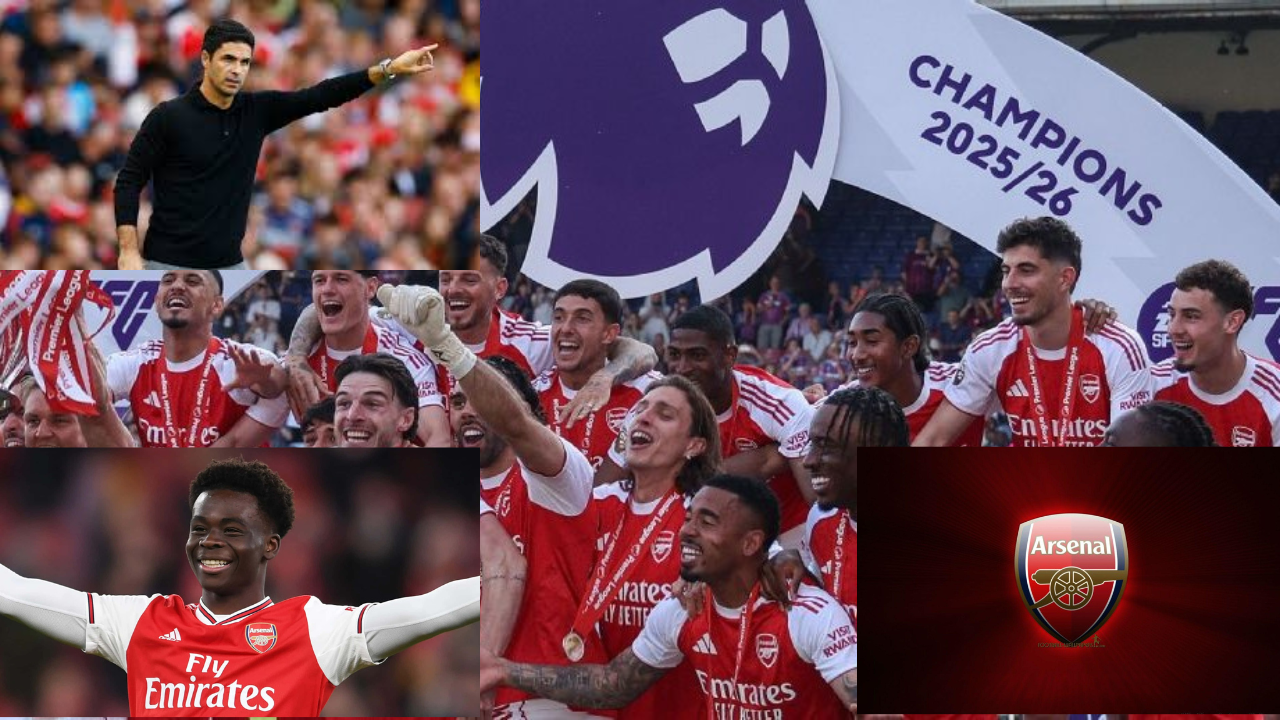
It took 22 years, over 8,000 days, and an entire shift in the human experience, but the wait is finally over: Arsenal are Champions of England once again.
When the Gunners last lifted the Premier League trophy back in May 2004, the world was a completely different planet. George W. Bush was in his first term, Facebook was a fresh-faced Harvard experiment, and the iPhone didn’t exist. In fact, the scourge that eats up most of the time on this planet, YouTube, didn’t even exist yet. If you wanted to witness Thierry Henry leave Jamie Carragher for dead at Highbury, you had to catch Match of the Day on BBC One or buy a grainy nostalgia DVD at the end of the season.
Today, that iconic solo goal has been clipped and streamed millions of times on social media feeds, serving as a digital reminder of a bygone era. In some years from now, it will be the David Raya save at West Ham or the Zubimendi blinder against Nottingham Forest that will be served endlessly on the feeds of football fans.
Back in that golden summer of 2004, Pep Guardiola was playing out his twilight years in Qatar, not knowing that he would eventually need a castle to keep the trophies he would win. Since then, he has redefined football like no one else, and not for nothing has he ended up being called one of the greatest managers of all time. And a 22-year-old Mikel Arteta was just finding his footing in Scotland with Rangers.
Today, in 2026, a new story is written. The Invincibles finally have company in Arsenal history. Arteta has come full circle, navigating the club through the highest highs and the memed-to-death lows of the internet age to bring joy to a fanbase that has endured more than two decades of heartbreak. And to make it sweeter, he matched his wits and won against his master Pep.
From Rock Bottom to the Summit
In the winter of 2019, when Arteta took the reins, he inherited a club that was going nowhere. The Gunners finished eighth in his first partial season, and backed it up with another eighth-place finish in his first full campaign. While City and Liverpool dominated, Arteta’s ability to restore Arsenal to England’s elite was heavily doubted. The noise amplified as the Gunners finished fifth in 2021-22. Arsenal had not played in Europe for six years, and things looked bleak.
But the tide was turning. Arteta was slowly but surely making changes. Every time the press asked, he held forth on the cornerstone of his “project”—as he preferred to call it—an unrelenting focus on setting new standards. He demanded them in training, in preparation, in behaviour, and in every corner of the club. He cleared out malaise and installed belief. Slowly, painstakingly, a new Arsenal was being put together.
The 2022-23 season announced their return. Arsenal led the Premier League for the majority of that campaign, giving the world a first thrilling glimpse of what Arteta was building. They eventually surrendered the title to Manchester City, but not before proving that resilience and consistency were returning to the Emirates. The fans were finally rallying around the team; the weekends at the Emirates became rousing and noisy as “North London Forever” rang out in absolute belief.
Then came the heartbreak of 2023-24, when City pipped them to the title by an agonising margin of just two points. And again in 2024-25, Arsenal finished as runners-up for a third consecutive season. Three times bridesmaids. Three times, so close.
The Season That Finally Delivered
The 2025-26 campaign opened with a statement: a thumping 5-0 victory over Leeds United at Emirates Stadium on a sun-drenched August afternoon. It was a declaration of intent. Arsenal sat atop the Premier League for the majority of the season that followed, playing with a swaggering confidence that felt, for the first time in a generation, genuinely sustainable.
The summer’s most significant business had been the £64 million acquisition of Viktor Gyökeres from Sporting Lisbon. The Swedish striker arrived with enormous expectations after an extraordinary spell in Portugal. Initially, Gyökeres struggled for rhythm, taking time to understand his teammates and the Premier League’s unique physical demands. There were murmurs. There were doubts. But Arteta remained publicly, conspicuously calm: “We know his qualities. He is undoubtedly an incredible striker. We need to feed his quality, we need to understand him better… I think we are on the right trajectory.”
He was right. By the turn of the year, Gyökeres had found his footing. He scored twice off the bench against Sunderland to put Arsenal nine points clear at the top, and from that moment, he was irresistible. He ended the campaign as the team’s top scorer with 12 league goals and 19 across all competitions, proving to be the man whose goals came at the most crucial, high-pressure moments.
Around him, the supporting cast was magnificent. Martin Ødegaard, the Norwegian captain, orchestrated from midfield with calm authority, tiptoeing his way through challenges with ease. Tight spaces were acres of land for him; he handled the ball as if it were a fragile fishbowl, too brittle to be booted around.
Bukayo Saka, Arsenal’s Hale End boy, continued his stunning rise into one of Europe’s finest players, providing creativity, goals, and an indefatigable energy. Gabriel Martinelli turned up as a specialist off the bench—his blinding run and lob over a towering Donnarumma was both a signpost and proof of a team that simply refused to tire.
Arteta was never shy of pushing academy players into the cauldron. Miles Lewis-Skelly bloomed under his manager’s vigorous backing, while the precocious Max Dowman was handled with perfect care. The kid responded by producing what was easily the brightest moment of Arsenal’s campaign: a twinkling run across the pitch on a late afternoon at the Emirates. Dowman hadn’t just run for goal; he had run himself into the history books, reminding every football fan, irrespective of the colour of their matchday shirt, of the pure romance of the game.
But if two players deserved to be described as the ultimate architects, it was Declan Rice and David Raya.
Rice was everywhere. He ran the lines, kept the midfield together, and worked like a machine. On countless occasions, he would be in the opposing box joining the forward line, and then, in a flash, sprinting back at full steam to help his defence. His work rate across the campaign defied our understanding of the limits of the human body.
Beside him, David Raya was a wall. His acrobatic fingertip save to deny Brighton’s Yankuba Minteh in December was a season-saver. But his close-range stop against West Ham was arguably the moment that defined this title race. Raya is a signing Arteta should be immensely proud of. A few eyebrows were raised when he first arrived; by the end of this campaign, all eyebrows were raised again—this time in wonder rather than doubt. Jürgen Klopp wasn’t off the mark years ago when he suggested Raya could easily wear a number 10 shirt for the way he distributes from the back.
The Wobble That Made It Sweeter
No great title win arrives without its ordeal by fire, and Arsenal’s was no different. In April, a 2-1 defeat away at Manchester City handed the initiative back to Pep Guardiola’s side, who overhauled Arsenal at the top of the table. It was a sickening echo of the collapses of 2023 and 2024.
The memes arrived within minutes. Social media, as always, was merciless. The “typical Arsenal” chorus rang out louder than ever. Jokes were a dime a dozen. One of the more devilish ones went: What is the difference between a book and Arsenal? A book has a title.
But this time was different. This was not a team without a backbone. This was a group that had spent years being tested by fire and denied by near-misses. The squad had learned to cut out the noise and plough on. In a moment that perfectly encapsulated their spirit—and will likely be immortalised in video packages for decades—Declan Rice was caught on camera mouthing the words, “It is not done,” right after the City loss.
They bounced back with four wins in a row, keeping four clean sheets, refusing to let the ghosts of seasons past infect their campaign.
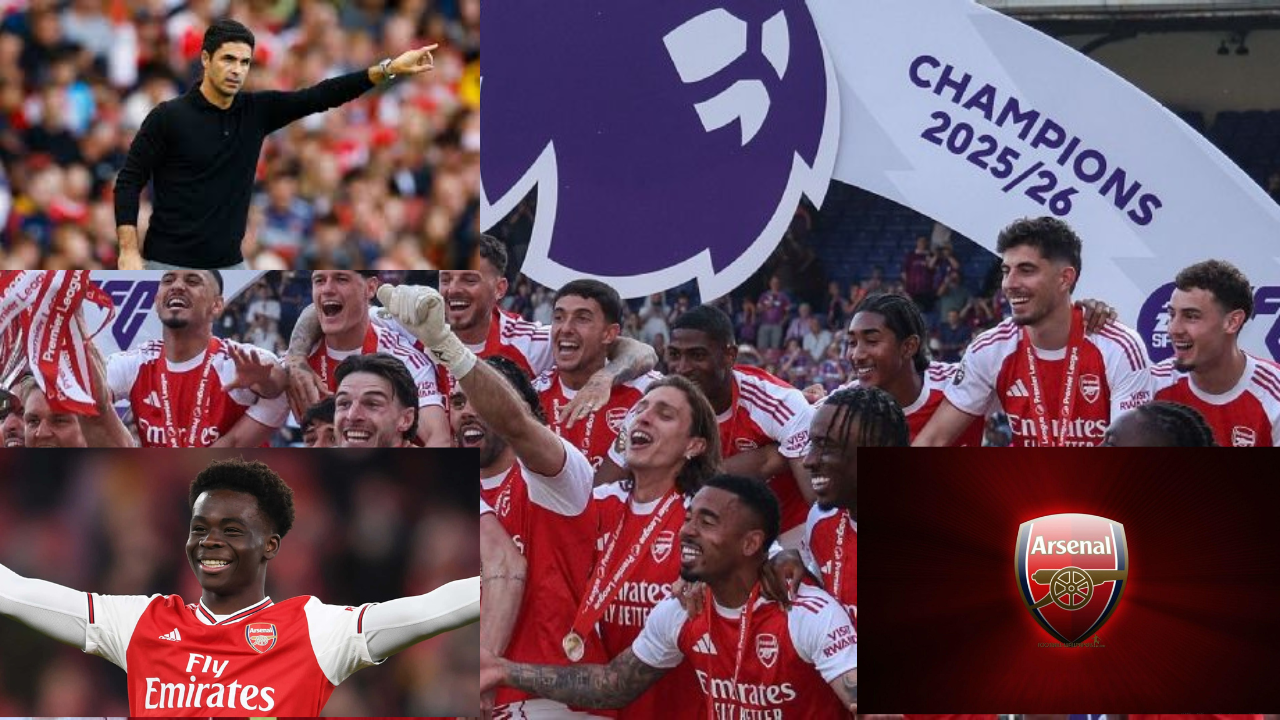
A home fixture against Newcastle in the final stretch became a must-win; Arsenal duly delivered. Then came a nervy, gritty, but well-earned 1-0 victory over Burnley. That win put them within touching distance of destiny. On the evening of Tuesday, 19 May 2026, the Arsenal players gathered at their training ground to watch Manchester City draw 1-1 at Bournemouth. They could no longer be caught. The title was theirs.
Declan Rice posted a picture on Instagram with his teammates, captioning it simply: “I told you all… it’s done.” Bukayo Saka, addressing a fanbase that had endured 22 years of mockery, put it best of all: “Twenty-two years, they were laughing, they were joking. They’re not laughing anymore.”
The Man Who Built the Miracle
There is poetic justice in the culmination of Mikel Arteta’s story. It is a script that Hollywood would find too far-fetched.
He began his journey in England as a cultured, intelligent midfielder at Arsenal and a player Arsène Wenger deeply trusted. He played his part in steadying the ship during a transitional era. He then graduated to management, learning his craft under Pep Guardiola at Manchester City before returning to Arsenal in December 2019 to take on the most daunting job in English football: rebuilding a sleeping giant.
With this title, he becomes the first former Arsenal captain to win the Premier League as a manager. It is not a statistic he simply inherited; he built this winning machine from rubble, brick by painstaking brick, season by punishing season.
Along the way, Arteta mastered the art of managing external pressure. He spoke with a measured confidence about “the process.” While many, including the journalists, could sometimes barely suppress their scepticism, Arteta believed. Every drill in training was purposeful. Every player he signed was chosen not merely for talent, but for character and for the ability to absorb pressure and refuse to break.
In 2026, Arsenal finished with an incredible record. And they are not yet done. Arteta’s men face Paris Saint-Germain in the Champions League final in Budapest at the end of May, chasing the first European Cup in the club’s storied history. As one pundit noted, “It almost feels like the Champions League final is a free hit now.” One suspects Arteta would disagree. Free hits do not exist in his vocabulary.
A Legacy Reborn
Arsenal’s fourth title of the Premier League era now repositions the club’s place in the modern footballing hierarchy. For a generation of supporters who had only ever known silver medals and tactical banter, these bare facts are staggering.
The Invincibles of 2003-04 will always occupy a singular, mythical place in football history for it was an unbeaten feat so extraordinary it may never be matched. But Arteta’s champions of 2026 are worthy heirs to that legend. They are not Invincible in the same way, but then they are something else entirely. They are survivors. They are grinders. They are a team that lost, and lost again, and came back harder every single time.
Back in 2004, Arsenal had no idea it would be over two decades before they lifted that trophy again. The world changed beyond recognition in the interim. An entire generation of fans grew up knowing nothing but the exquisite agony of being a modern Arsenal supporter.
Now, the trophy is home. The flags are flying high over North London. And somewhere in the haze of the celebrations, every fan who endured the journey understands what it means to believe in something for longer than it makes rational sense and to keep the faith when the events test you most.
In the end, Arsenal’s triumph of 2026 reminds us of a fundamental truth: the distance between defeat and glory is never bridged by talent alone. For twenty-two years, Arsenal kept choosing to believe. And the universe, as it always does for those who persist long enough, eventually answered.