
Isles of Scilly Football League
Towards the South of England, the land stretches into the ocean like an appendage. The very tip of this protrusion is the Land’s End, a popular tourist spot.
A few miles further west into the Atlantic lies an archipelago that can hardly be spotted on the map. It is when one zooms in that the Isles of Scilly emerge from the blue ocean carpet on the map.
The Isles of Scilly comprise approximately 140 small islands, with St Mary’s Island taking centre stage. A small, cute island with a population of about 2000, it is as remote as it can get.
Separated from the mainland and surrounded by treacherous Atlantic waters, St. Mary is home to a population that sustains itself through tourism income and a few local enterprises, including flower farming and boat building.

On this Island , on a windswept Sunday afternoon at the end of September every year, while the Premier League has already kicked off on the mainland and is being viewed across the world on television, a wonderfully strange game kicks off an equally unique league.
Welcome to the Scilly Football League, the smallest Football league in the world.
No floodlights. No VAR. and No transfer drama. It is football in its most rustic form, just a handful of ordinary men keeping their worldly pursuits on hold and pulling on boots, tugging jerseys over jumpers, and trudging across a patch of grass that doubles as the Isles of Scilly’s entire footballing universe.
The League is the smallest because it has just two teams. That’s it. No relegation dogfights. No promotion dreams. Just Garrison Gunners and Woolpack Wanderers, locked in an eternal, neighbourly rivalry that resets itself every season like the tide.
They play each other, again and again, through the winter months, usually on a single pitch at Garrison Field on St Mary’s. Same ground.
The same faces. The same wind howling in from the Atlantic like it’s got a personal vendetta.
And yet, it’s football in its purest form.
Let the Game begin : Matchday at the Isles of Scilly
Matchday on Scilly doesn’t begin like it does on the mainland. There are no travelling fans, no jammed trains or club chants. It starts with checking ferry times, helping your mate finish his shift, and hoping enough players turn up.
Squad depth is a luxury. If one team is short, players are “loaned” across to the other team for the afternoon. Yes — you can tackle a man in the first half and pass to him in the second. Try explaining that to a modern football fan.
Before the League begins, the two captains sit together and select their teams, one player at a time, from the pool, just like you do in your school. The team would be different every year, and there are no permanent allegiances.
The idea is to play the beautiful game without its modern-day distractions.
There are no substitute benches, and no coaches taking notes and making tactical adjustments. There’s often just one referee, doubling as linesman, mediator, and sometimes reluctant dog-wrangler when a local pet decides the centre circle looks inviting.
The crowd? They are not the drunk, chanting, club jersey-wearing bunch. It is just a few Islanders with some free time wrapped in coats, leaning on railings, offering commentary that is brutally honest and completely impartial — unless your cousin or your wife’s brother is playing, of course.
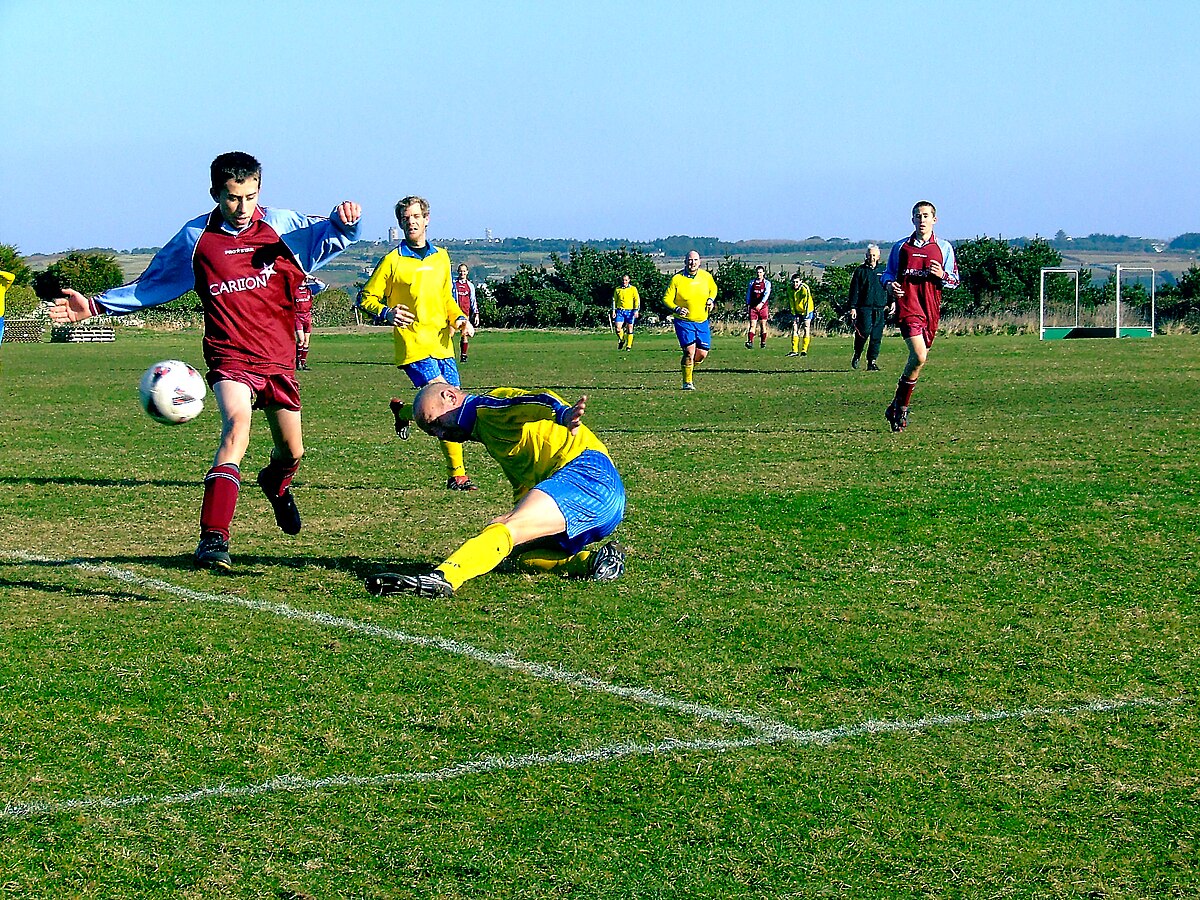
The goals don’t arrive with choreographed celebrations or smooth moves. They come from anywhere. A deflection off a boot, a hopeful swing of the feet in the general direction of the goal, helped by swirling wind. A goalkeeper misjudges a cross because the ball simply disappears into a grey sky.
When the net ripples, there’s a roar — not of tens of thousands, but of people who know exactly who scored, where he works, and what he’ll be hearing about it in the pub later in the evening when the dust settles.
The Woolpack Wanderers, named after a local pub, proudly wear their heritage. The Garrison Gunners, equally proud, treat every fixture like a cup final — because, in a way, every fixture is.
With only two teams, there’s nowhere to hide. No easy run. No “next week we’ll bounce back.” If you lose, you stare at the same opponent again soon enough, replaying missed chances in your head while the Atlantic batters the shoreline.
Football in it’s purest rustic form
What makes the Scilly league special isn’t novelty, though that’s what draws the headlines. It’s the stubborn insistence that football belongs anywhere people care enough to lace up boots.
In winter storms that would postpone matches elsewhere, they play on. When players move away, others step up to take their place. Teenagers share a pitch with men twice their age.
Generations overlap. Stories accumulate and a yet another year goes by.
There are no home or away fans; it is all just a social spectacle where Football wins every time a ball is kicked.
In an era obsessed with scale — bigger stadiums, bigger contracts, bigger broadcasts — the Isles of Scilly Football League whispers a different truth.
Football doesn’t need an empire to feel epic. Sometimes all it needs is one pitch, two teams, and a community that turns up, week after week, because this is their game.
Some stories sound unreal. Once, a player had to drop out mid-season as he got a job in the Swiss Alps. On another occasion, a player had to be loaned across as one of the opponents on the pitch got a phone call informing him of the escape of his cows. The place is a friendly reminder of the small twists of life.
When the final whistle blows, and boots are scraped clean on the grass, players wander off together.
Rivals a moment ago, friends again now. The sea keeps roaring. The islands settle back into quiet. And somewhere, far from the noise of the global game, football carries on — small, stubborn, and utterly alive.
For those obsessed with statistics, the Garrison Gunners have won the title 20 times, while the Wanderers, the current champions, have held the cup 17 times. The highest scorer is said to be Andrew Hicks with more than 180 goals in 150 matches over 15 years.
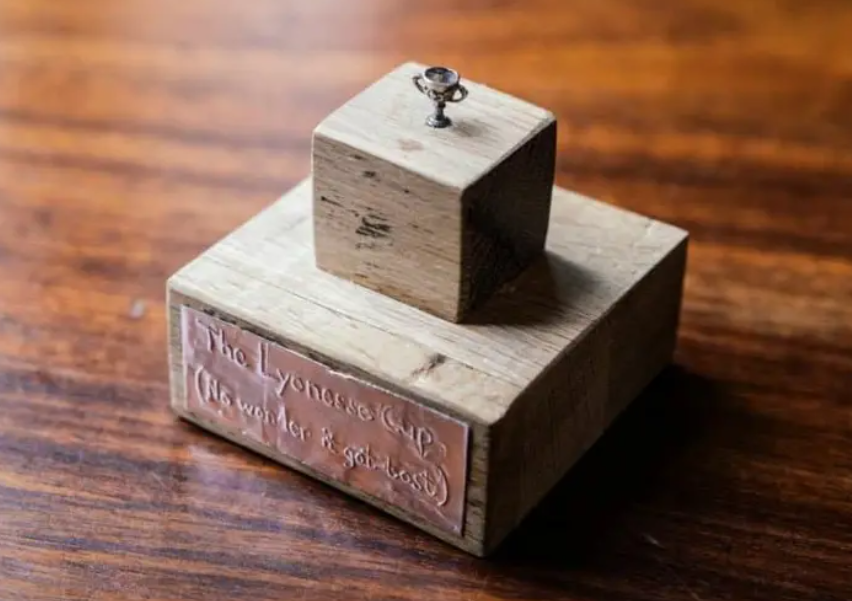
There are a few more cups to keep the flow going, like Wholesalers Cup, Foredeck Cup, Charity Shield, Galley Cup, Scillonian Club Cup and Lyonnese Cup.
The last one is an invitational inter-island cup, and the winner in this competition gets the smallest trophy in the footballing world – all of 6 millimeters in height.
The Show must go on : for Football’s sake
The show has been on for about a hundred years now, and it continues. Sport played as it should be, always pure, entertaining and unpredictable—a world where the distractions of fame and the scourge of commercial revenue are unknown.
Football is in its purest form, one that it was always supposed to be , a social event where the folks get together to spend some time after work and build bonds and friendships.
In these times where simplicity is long lost, may the League of Scilly continue as it is today – simple, carefree and in all its innocence.
May it last as long as the howling winds from the cold Atlantic swirl around these islands.
==============
Sudhir Bhattatthiripad


Very well researched. The smallest league. Only two teams—Garrison Rovers and Woolpack Wanderers.
Thanks sir
What a poetic & beautifully written description of the Scilly Isles.
It was a pleasure to read about the simplicity of this football team.
Long may their football continue to be played and enjoyed by all.
I’m impressed!
Sue B
What a poetic & beautifully written description of the Scilly Isles.
It was a pleasure to read about the simplicity of this football team.
Long may their football continue to be played and enjoyed by all.
I’m impressed!
Sue B
Thanks Sue. Good to know that you appreciate the story. Thanks again.